





Industrial Radios Breathe New Life Into Old Quarry
Industrial Radios Breathe New Life Into Old Quarry
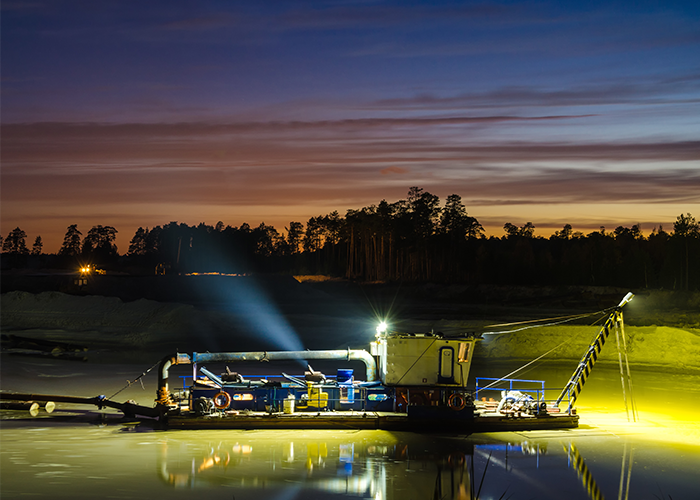
Just outside of a small town in Missouri, an operator watches the cutting arm of his dredge on sonar. Silently the arm descends into the murky water and neatly intersects with the sandy bottom. The automated vacuum control system on the cutter head pumps the wet sand at a rate of 6,000 gallons per minute, through a 2,000-foot pipe, underground and across a lake to the classifying plant. Once there, the sand is pumped to the top of the 70-foot plant, then is filtered and stacked into product piles ready for transportation. Wireless industrial radios instantly report minute changes in pressure and flow in the pumps and keep the operator in constant communication with the controllers in the classifying plant nearly a half-mile away.
Though reminiscent of a sci-fi movie, this scene represents the brainchild of the corporate engineer at a sand and gravel company in Missouri.
Using Microsoft Access and Excel in conjunction with Allen-Bradley’s RSView®, they now have production reports that were never available before.
“It has definitely increased our data-gathering capabilities and allowed us flexibility in the use of the man-power needed to run this operation, saving us approximately $100,000 per year,” the engineer said. “Also, with the old system the pipe would get plugged several times a day. Now, as fast as ControlLogix® is, we can anticipate plugs and we haven’t had one since the new system went online.”
“I’m new to the mining industry,” he added. “So when I started to work here I asked a lot of questions.”
He was surprised to learn that most of the technology used in the dredging operation was over 30 years old and obsolete. Everything was done manually, with no way to even measure pressure or flow from each of the pumps. When he asked the dredge operator how he could see what he was digging into under the water, he was told that they “felt” their way along.
Much of the system controlling the vacuum at the cutter head inlet needed to be replaced. The electrically operated control valve and control panel were a proprietary system that was inadequate for the needs of the operation. The old angle sensor on the cutter head also needed to be removed. Since the dredge rises and falls when the cutter head is touching the bottom or free floating, it was impossible to determine a true cutter arm angle.
Going Wireless
In order to solve these problems, improve efficiency and coordinate the dredging with the classifying plant, a fully automatic system was needed. The first change the engineer was determined to make involved installing radios in the dredge to communicate with the pumps and the classifying plant.
“I wanted to use wireless,” he said, “because wire is such a big headache.”
He started with consumer-grade radios.
“The classifying plant is on the other side of a major highway. The consumer radios were a disaster. They shut off when a plane flew by. We had several industrial radio companies look at this application. Some told us it couldn’t be done. Others told us we would need expensive repeaters. ProSoft Technology came along and simply did it. ProSoft’s modems are by far the most robust radios I have ever found. [The wireless family] is a complete wireless Ethernet package. For this application it was just plug and play.”
“Every wireless application is unique,” said the ProSoft wireless application engineer who worked on the application. “It is imperative that any company providing wireless communication know the specifics of the application. Critical information that should be considered before purchasing a wireless network include: How far does data need to be transmitted? Are there any obstacles such as buildings or mountains impairing line-of-sight between radios? In what type of application will the radios be used, i.e. oil and gas pipeline, manufacturing plant, electric welding, etc. If the integrator does the proper leg-work up front, the reliability of the radios is a given.”
A ProSoft Ethernet modem was placed at the classifying plant, the pump station, and on the dredge. The classifying plant is nearly half a mile away from the dredge, which sits in the water-filled quarry. In order to achieve line-of-sight between the two, the antenna at the classifying plant was placed on top of its 70-foot height. Another antenna was placed on the barge and a third at the remote booster pump station. No repeaters were needed.
Updating the Automation Equipment
Local distributor Van Meter Industrial and ProSoft’s sales manager assisted the end user in choosing the automation needs for the new system.
A 200R Industrial PC was installed in the classifying plant communicating with an Allen-Bradley® SLC™ 5/03 processor. This data, including plant processes and production reports, is viewed via RSView® on a VersaView 1700M. A ControlLogix® processor was installed at the dredge communicating with another VersaView monitor. A MicroLogix™ processor was installed at the remote booster pump station to monitor pressure and flow. It also allows the pump to be started and stopped from either the dredge or the classifying plant.
The Classifying Plant
The new PC in the classifying plant serves several functions:
- It provides a Graphical User Interface (GUI) through a touch-screen monitor. The GUI enables operators to change states of the field devices (manual, off, auto), and change variables that affect the process such as gravel product pile locations, classifying cell timers, etc.
- The PC collects data from field devices such as the remote booster PSI, TPH from the product scales, downtime, etc.
- All of the classifying plant control tags are served to the dredge PC so that remote viewing and control of the classifying plant is obtained. The classifying plant PC also provides all the information from the remote dredge PC, allowing operators to view all dredge information.
The Dredge
Along with the automation upgrades, the dredge also underwent a major electrical overhaul. The pushbutton-type control system was removed. A processor/PC-based system was implemented to accomplish a one-button startup. All dredge motors and pumps are now started with the touch of a button. The PC monitors flow, pressure, and motor amps on all devices, ensuring that the start sequence works every time without damaging the equipment.
A new Convac system was installed to replace the aging, proprietary equipment.
“The new Convac system works with ‘off-the-shelf’ standard hydraulics and a new multivariable control scheme,” the end user’s engineer said. “I had the opportunity to see the valve work with a material cave-in, and the new system handled it in a rapid and controlled manner.”
Complete Control
Now the fully automated dredge can run not only the dredging operation but also the booster pumps, as well as the entire classifying plant via the radios. Sonar was installed on the dredge, which is displayed on the VersaView monitor via RSView, giving the operator a clear view of the cutting arm and the sandy quarry bottom.
“We also installed a positioning sensor on the dredge that uses the magnetic field of the earth to tell us the heading of the dredge, its pitch and yaw, and the angle of the cutting arm,” the engineer said. “This allows us to know the exact depth of the sand at any given time.”
With all this new technology, the efficiency and cost-effectiveness of the operation has been greatly increased. As the engineer put it, “Now all the dredge operator has to do is drive the boat!”
Learn more about ProSoft Technology’s Wireless Solutions here.