



• English
  • 中文
  • Français
  • Deutsch
  • Español
Contact Us
Home
Email
Follow Prosoft Technology on Twitter
Follow Prosoft Technology on Facebook
Follow Prosoft Technology on LinkedIn
Follow Prosoft Technology on YouTube
    • PROFINET Controller Module for ControlLogix®
    • EtherNet/IP™ to DH+ Gateway
    • Two-Port Building Automation Gateway
  • Solutions
    • Amusement
    • Automated Material Handling
    • Automotive
    • IIoT Solutions
    • Mining and Metals
    • Modernization
    • Oil and Gas Solutions
    • Secure Remote Connectivity
    • Water & Wastewater
  • Produkte
    • Fernzugriff
    • Rockwell Automation In-chassis
    • Gateways
    • Industrial Wireless
    • ProSoft-Software
  • Service & Support
    • Knowledge Base
    • Regionaler technischer Support
    • Legacy Downloads
    • Training
    • Return Material Instructions
    • Literatur bestellen
  • News & Events
    • ProSoft Insights (Blog)
    • Podcast
    • ProSoft Insights / Technologie Focus

      Which Switch for PROFINET?
      Contact Us

      Search Insights

      Kategorien

      • Referenzen
      • Technologie Focus
      • News & Events
      • Videos
      • Partners interviews
      • Produkt Fokus
      • White Paper
      • Work Smarter
      • Application Guides

      Tags

      • In-chassis
      • Gateways
      • Wireless
      • Energiemarkt
      • Leaky Feader Kabel
      •  Automotive
      • Öl und Gas
      • Modernisierung
      • Wasser
      • Fernwartung
      • Abwasser
      • Fahrerlose Transport Systeme
      • IIoT
      • Flow Computing
      • Legacy
      • Cellular/GSM
      • Amusement
      • CIP Safety
      • Food and Beverage
      • Logistics
      • Protocol Conversion
      • Edge

      Letzte Posts

      Here's Where You Can Find ProSoft News

      06 Feb, 2026 / News & Events

      The blog itself will stay live, but you can now find news about ProSoft Technology and ...

      Why a Strong Data Foundation is a Must in AI for Manufacturing

      24 Nov, 2025 / Technologie Focus

      To truly scale AI for manufacturing, the foundational step is to build a unified and ac...

      Know Your Network Before You Set Up Your Automated Warehouse System

      30 Okt, 2025 / Technologie Focus

      Before any advanced automated warehouse systems can deliver on their promise, a critica...

      Improve Your Warehouse’s Efficiency with Secure Connections

      09 Okt, 2025 / Technologie Focus

      Your warehouse’s intricate dance of logistics and efficiency hinges entirely on a robus...

      • Donnerstag, 20. April 2017
      • Carl Henning - Then-Deputy Director, PI North America
      • Gateways

      Which Switch for PROFINET?

      Should you use a managed switch or an unmanaged switch with PROFINET? YES! Yes, you should use either a managed or an unmanaged Ethernet switch with PROFINET.


      Unmanaged Switches

      An unmanaged switch has no built-in intelligence except to send incoming Ethernet frames out the correct port – the port to which the destination device is connected. And only that port. For diagnostics it has LEDs. Each port has an LED indicating that there is Ethernet traffic. There is no way to tell how much bandwidth is being consumed. There is no way to tell if there are lots of re-tries. You can buy such a switch at many retailers. For example, there is a 5-port Linksys switch available for $33.99. It meets the minimum requirements for PROFINET; that is, it’s a 100Mbps full-duplex Ethernet switch. It also includes the Quality of Service (QoS) feature that is recommended for PROFINET. Since PROFINET frames are automatically marked with a priority higher than TCP/IP frames, a PROFINET frame gets a head start if a TCP/IP frame and PROFINET frame arrive at the same time. The PROFINET frame gets sent out first.


      Managed Switches

      A managed switch adds intelligence that an unmanaged switch does not have. A number of IT protocols are useful with managed switches including Simple Network Management Protocol (SNMP), Link Layer Discovery Protocol (LLDP), and Internet Group Management Protocol (IGMP). Let’s dispense with IGMP right off the bat – PROFINET does not need it. Protocols that multicast their real-time IO data do need it. PROFINET unicasts. SNMP and LLDP are specialized protocols for retrieving data that switches save. For example, if you think it is important to be alerted if there is an excessive number of re-tries, SNMP can help. If you want to see what bandwidth utilization is in real-time, SNMP can help. LLDP allows software to extract the network topology. LLDP also enables one of the wow-factors of PROFINET: Replacing a device with no software tools needed and no switches to set. 

      There is a saying that goes: “You will either use a managed switch… or wish you had.”

      A managed switch provides information that can help prevent downtime and speed troubleshooting when the line does go down. The more expensive downtime is in your facility, the more important it is to invest in a managed switch. It is an investment. Managed switches cost more. But the incremental cost is trivial compared to the cost of downtime. Up to now, you probably think this topic covers standalone Ethernet switches. That is true. But managed switches are also contained within PROFINET devices. So the same kind of diagnostic information you can extract from a standalone switch can be extracted from a switch in a PROFINET device.

      You can use an OPC-SNMP server to read information from a managed switch and display it and alarm it in an HMI. It’s wonderful that the information can be seen in an HMI, but what if you want the controller to take some action as a result of diagnostic information? PROFINET does that.


      PROFINET Switches

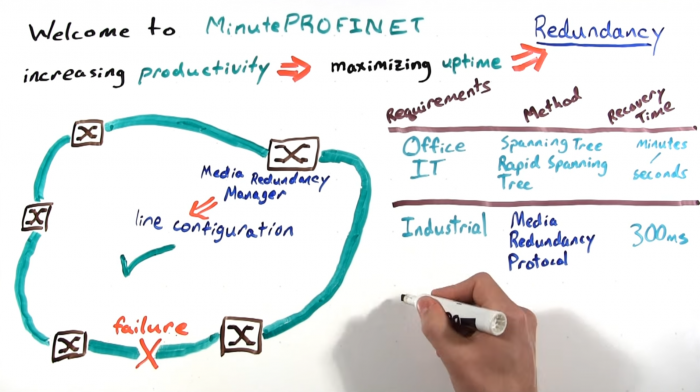
      An Ethernet switch can also be a PROFINET device! The switch will look like IO to the PLC. This means the switch will have a GSD file just like any other PROFINET device. And the GSD file will define what diagnostic information can be read. For example, if a device is unplugged from a switch port, the PLC logic can execute an appropriate action. This is even more valuable if the switch is an MRP device (Media Redundancy Protocol). 

      If the switch reports a failure in the ring, the PLC can alarm it and act on it. In fact, it can pinpoint where the break in the ring is, simplifying the maintenance response. 

      With PROFINET you can use an unmanaged switch, a managed switch, or a switch that is also PROFINET IO. It’s good to have options. But, even though you can, don’t use an unmanaged switch unless you can afford… the downtime.


      Source: http://profinews.com/2017/01/tech-tip-which-switch-for-profinet/


Solutions

  • Amusement
  • Automated Material Handling
  • Automotive
  • IIoT Solutions
  • Mining and Metals
  • Modernization
  • Oil and Gas Solutions
  • Secure Remote Connectivity
  • Water & Wastewater
$(document).ready(function(){ $('.popup-youtube, .popup-vimeo, .popup-gmaps').magnificPopup({ disableOn: 700, type: 'iframe', mainClass: 'mfp-fade', removalDelay: 160, preloader: false, fixedContentPos: false }); //pagelayout banner? if($('.banner-image') !== 'undefined' ){ var banner_image_src = $('.banner-image img').attr('src'); $('.banner-image').hide(); $('.banner-page-title').css('background-image', 'url(' + banner_image_src + ')'); $('.banner-page-title').css('background-repeat', 'no-repeat'); } //if( $('.analytics-file-download' ) !== 'undefined' ) { // $('.analytics-file-download' ).click(function(){ // var action = $( this ).attr( 'href' ); // var label = $( this ).attr( '_gaq-label' ); // var category = $( this ).attr( '_gaq-category' ); // return ga('send', 'event', category, action, label); // }); //} //initialize search? $("#div_search_field input").focusin(function(){ $(this).css("color", "#000000"); }); var initialSearch = $('form.search input.text').attr("value"); var currentSearch = ""; $('form.search input.text').focusin(function(){ currentSearch = $('form.search input.text').attr("value"); if( currentSearch == initialSearch ) { $('form.search input.text').attr("value",""); } }); }); //Homepage slideshow if( $('#slider') !== 'undefined' ) { $('#slider').nivoSlider({ pauseTime: 7000 // time for a slide to show, in milliseconds; subtract 2 seconds for actual time due to transition time }); } //eZ Live Viewer //(function(){var ff=document.createElement('script');ff.type='text/javascript';ff.async=true;ff.src=('https:'==document.location.protocol?'https':'http')+'://liveviewer.ez.no/statjs/sst-118-973155090/stat.js';var s=document.getElementsByTagName('script')[0];s.parentNode.insertBefore(ff,s);})(); // Pardot integration piAId = '281892'; piCId = '1546'; (function() { function async_load(){ var s = document.createElement('script'); s.type = 'text/javascript'; s.src = ('https:' == document.location.protocol ? 'https://pi' : 'http://cdn') + '.pardot.com/pd.js'; var c = document.getElementsByTagName('script')[0]; c.parentNode.insertBefore(s, c); } if(window.attachEvent) { window.attachEvent('onload', async_load); } else { window.addEventListener('load', async_load, false); } })();